Fireworks
Fire Marshall could ban sales of incendiaries at the start of fire season
Register-Guard, letter to the editor, July 2, 2005
Fireworks hazardous to homes
Since local governments claim to be concerned about urban fire prevention in a drought year, why is it legal to sell tons of fireworks at the start of fire season?
On July 4, 2003, the South Hills came close to a conflagration due to kids playing with fireworks. A large sequoia tree on Hillside Drive (near West Amazon Drive) was set on fire about noon, when it was hot and windy. If this had been a couple of blocks to the south, Spencer Butte Park could have gone up in flames.
Friends of mine in the neighborhood were extremely concerned that it would spread and destroy their home. They used a garden hose to wet their house while waiting for the fire department to arrive.
The fire marshal reportedly has the authority to prohibit these sales for public safety. But do politicians have the political courage to do this, or are they waiting until there's a major fire in the South Hills to take prudent, prevention measures?
I'm sure there would be some people upset that they can't celebrate freedom by exploding incendiary devices made in Chinese military factories. But there would be many more people upset if a firestorm destroyed part of the town.
I hope my concerns are exaggerated and the firefighters of Eugene, Springfield and Lane County are standing by to quickly extinguish all fireworks-caused blazes before they cause property damage and threaten lives.
MARK ROBINOWITZ
Eugene
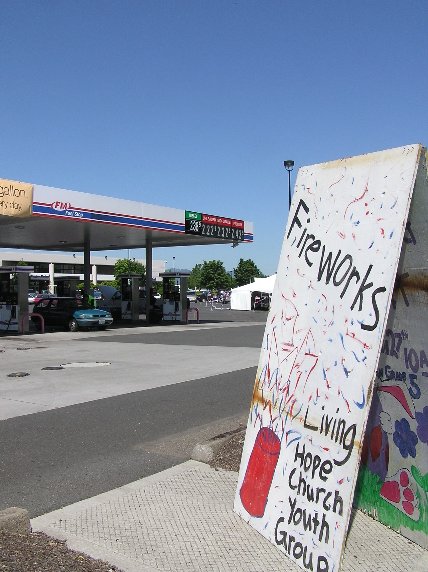
fireworks and gas station in west Eugene
http://cliffmass.blogspot.com/2017/07/personal-fireworks-should-be-banned.html
Personal Fireworks Should Be Banned
toxic air pollution, exacerbation of PTSD, wildfire dangers
Grass Fires Char Homes in Oklahoma, Texas
Email this Story
Dec 27, 9:19 PM (ET)
By TIM TALLEY
(AP) A fire claims the last section of a mobile home in Arlington, Texas, Tuesday,
Dec. 27, 2005.
Fires fueled by dry brush and driven by gusty wind damaged several homes in Oklahoma and Texas on Tuesday. Several firefighters and residents suffered minor injuries, authorities said.
In Oklahoma, the biggest fire burned at least 400 acres in a rural area near the town of Mustang, southwest of Oklahoma City.
Texas Gov. Rick Perry said dozens of fires, mostly in north and central parts of his state, prompted him to deploy firefighters and issue a disaster declaration.
"It's like trying to stop a 30-mph car coming down the street," Texas Deputy Fire Marshal Keith Ebel said. "The wind is the worst enemy right now."
TV station helicopter footage showed at least a half-dozen structures were burned in Mustang, but conditions appeared to improve by late afternoon, when fire crews brought the flames under control.
"We've still got some hot spots that we're concerned about," Mustang Police Chief Monte James said.
He said firefighters battled flames at four houses and sheds. One firefighter was being treated at a hospital for smoke inhalation.
After the flames passed, residents emerged and were "watering their yards and standing in their yards," said Harold Percival, who lives about a mile from the Mustang fire.
"What can you do about it," Pat Hankins, 62, said as he watched his one-story home burn. "You have no control."
Hankins' friend Maria Vantour-Smith said flames hopscotched around Hankins' property before reaching his home.
"It just kept jumping. I've never seen anything like it," she said. They were able to remove a few antiques and other items from the home before it was gutted.
Several other grass fires were brought under control in three areas of Oklahoma City. One firefighter suffered heat exhaustion, and a child suffered minor burns on his hands when a shed caught fire.
That blaze was apparently started by children playing with fireworks, Oklahoma City Fire Maj. Brian Stanaland said.
"We've had warm temperatures, no moisture, low humidity and winds, so any little spark and man it just goes," Stanaland said.
Fire burned across Bryan County in southeastern Oklahoma. The most severe destroyed at least three structures near Achille and resulted in an unknown amount of injuries, mostly from smoke inhalation, said Tim Cooke, the county's emergency management director.
"Our entire county is just about on fire," said "It's everywhere."
Smoke from other grass fires reduced visibility along Interstate 35, forcing officials to close a stretch of the highway in southern Oklahoma near the Texas line.
The wind in Oklahoma was clocked at 25 to 35 mph, with gusts as high as 40 mph.
In Texas, Fort Worth Fire Department Lt. Kent Worley said crews had fought nine brush fires during the first half of the day and he expected more. His department also helped battle a blaze in nearby Kennedale. The Dallas Morning News reported that flames in Kennedale threatened two apartment complexes.
Three Arlington firefighters were hospitalized with smoke inhalation and heat exhaustion, said Battalion Chief David Stapp. The fires there threatened new housing developments and apartments.
In Hood County, a fire near Canyon Creek forced at least 100 people to evacuate, said Chief Deputy Jerry Lind. He said several structures were on fire, and propane tanks had exploded.
"We've got fires burning structures in several counties," said Tracy Weaver of the Texas Forest Service. "It is just critically, critically dry out there right now."
---
Associated Press writer Matt Curry in Kennedale, Texas, contributed this report.
http://pittsburghlive.com/x/pittsburghtrib/s_568019.html
High fireworks prices add up to less bang for buck
By Jason Cato
TRIBUNE-REVIEW
Saturday, May 17, 2008
Soaring prices and a dearth of shipments from China are threatening the U.S. fireworks industry, which could spell trouble for some Independence Day celebrations.
"Unfortunately, I think a lot of people are going to be without fireworks," said Stephen Vitale, president of New Castle-based Pyrotecnico, one of the country's largest professional display fireworks companies.
The head of Zambelli Fireworks, New Castle's other pyrotechnic giant, agreed with his competitor.
"I think there are going to be towns and festivals that are going to have problems," said Zambelli President Doug Taylor, who doesn't expect communities in this region to be affected this year.
Product costs have skyrocketed as much as 45 percent in the past year, and the average cost of a July 4 fireworks display, about $10,000, is likely to double in coming years, Vitale said.
Yet industry officials say the biggest problem is getting products out of China, the world's leading fireworks exporter. That has set off a panic across the industry, they say.
Officials from the U.S. departments of Transportation and Commerce begin a four-day meeting today with Chinese officials to discuss plans to shut down the shipment and production of fireworks and other explosive materials during the Summer Olympics in Beijing. Industry experts believe the Chinese government plans to impose the ban from July to October, and fear that will only exacerbate problems next year.
A 2006 fire aboard a freighter carrying seven containers of fireworks off the coast of Yemen scared off all but one of eight shipping lines that transported professional fireworks, which were erroneously blamed for causing the explosion, according to Bengt Henriksen, who owns a California company that specializes in shipping hazardous material. As a result, shipping costs are up 50 percent in the past year, he and others said.
In March, illegally stored fireworks sparked explosions and fires that destroyed 20 warehouses at the Sanshui port, which handled up to 70 percent of China's fireworks exports.
Display fireworks are shipped only from Beihai, a small port in southern China. It is believed that 400 of the 900 containers of professional fireworks that are shipped annually to the United States are waiting at the port, said Joe Bartolotta, president of Fireworks America in Lakeland, Calif.
In September, he ordered five containers of fireworks, for which he pays up to $100,000 each. Three are still in China.
"I've never seen anything like this," said Bartolotta, a former president of the National Fireworks Association. "We just cannot get that stuff moved out of China."
Other factors feeding the shortage include a weak U.S. dollar, the Chinese government's reduction in tax rebates to fireworks companies and China's burgeoning domestic fireworks market, which went from nearly nonexistent to the world's largest when the Communist government lifted a ban on fireworks in 27 provinces.
The retail fireworks industry has not been affected by shipping issues, said Alan Zoldan, executive vice president of Phantom Fireworks in Youngstown, Ohio. There are five shipping lines that transport less-powerful consumer fireworks, such as the ones Phantom sells at its 50 retail stores and thousands of temporary stands.
But that doesn't mean Zoldan isn't concerned. He said his prices have gone up 20 percent this year, and he expects the same in 2009.
From January to June of last year, Chinese manufacturers made 22.45 million cartons of fireworks, according to Fireworks Business, an industry newsletter. More than 9 million cartons were shipped to the United States, with more than 13 million cartons sold in China.
The fireworks supply to the United States is down about 40 percent, said Julie Heckman, director of the American Pyrotechnics Association. She expects a 20 percent reduction in the fireworks supply for July, the industry's busiest month. Cargo must sail by May 28 in order to arrive on time, she said.
"There's nothing we can do about July 4th," Heckman said. "There's no other port. There's no other way to get the product here."
The industry wants a long-term plan and needs help from the federal government to persuade China to provide more viable ports, Heckman said.
Vitale, who plans to leave for China on Sunday, said it's critical for the entire industry to get involved.
"We're searching for good, long-term solutions for this problem," Vitale said. "These products are not just coming to the United States; China supplies the entire world."
Jason Cato can be reached at jcato@tribweb.com or 412-320-7840.